We envision a world where all people live, work and play in their chosen communities throughout their life course.

As a University Center for Excellence in Developmental Disabilities (UCEDD), we work to promote self-determined lives for people with disabilities. As an institute within an urban research university, we work to promote access to opportunities and resources for unserved and underserved populations – especially people with developmental disabilities. We accomplish this by building partnerships that lead to effective social change through research, training, community development and information sharing.

We support and exemplify the University of Missouri-Kansas City’s strategic pillars.

Our Impact

33,345

Training videos, guides, EZ Readers and other products disseminated

7,456

Students participated in community training and education

1,612

Hours of technical assistance provided

4,632

Individuals received technical assistance

2,561

Individuals participated in IHD research or evaluations

Building Partnerships for Effective Social Change

Community Services

We offer demonstration, training and technical assistance to support people with disabilities.

Research and Evaluation

We help our partners gain insight to make an impact.

Interdisciplinary Education

We teach college students to work in the field of disabilities.

Library

We develop resources and tools to strengthen communities.

The University of Missouri-Kansas City’s Institute for Human Development (IHD) operates multiple programs aimed at promoting access to opportunities and resources for unserved and underserved populations, especially for people with developmental disabilities.

A graphic featuring an image of multiple brain scans with the text Advancing Brain Injury-Informed Victim Services in Missouri.

IHD and Partners Advance Brain Injury-Informed Victim Services in Missouri

IHD continues to advance brain injury-informed services for survivors of domestic and sexual violence through partnerships that bridge the fields of victim services, healthcare, brain injury and disability support. As a member of the Congressional Brain Injury Task Force and a facilitator of a national special interest group focused on intimate partner violence and brain injury, Researcher Beth Dauber is working to connect research, policy and practice to improve outcomes across the nation.

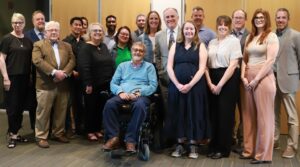
Graphic for Charting the Lifecourse in South Korea featuring a group photo.

Charting the LifeCourse Expands Global Impact

UMKC-IHD leaders Sheli Reynolds and Amanda George traveled to South Korea to support growing efforts to advance person-centered practices through the Charting the LifeCourse framework. Their 10-day visit brought together advocates, families, providers, and policymakers committed to building more inclusive supports and systems for people with disabilities.